The problem every long campaign has
A wiki tells you what is true. It has no opinion about when that started being true, which is fine for an encyclopaedia and useless for a campaign.
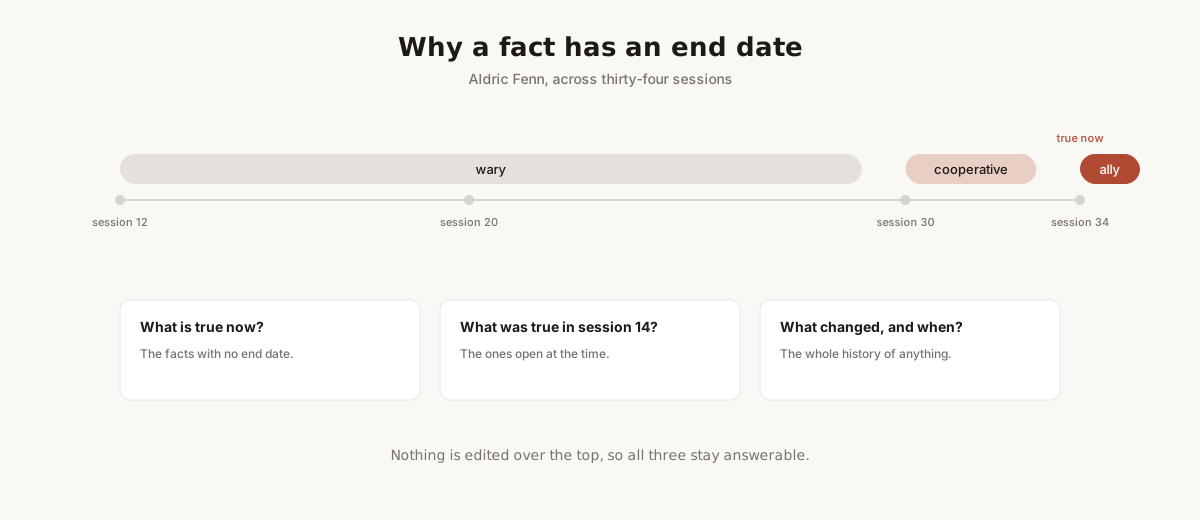
Aldric was wary of the party in session 12 and an ally by session 30. If your notes only hold “ally”, the story is gone. If they hold both with no sense of order, you cannot tell which is current. And when you write a recap of session 14, you need the one that was true then.
Everything is a record you can open
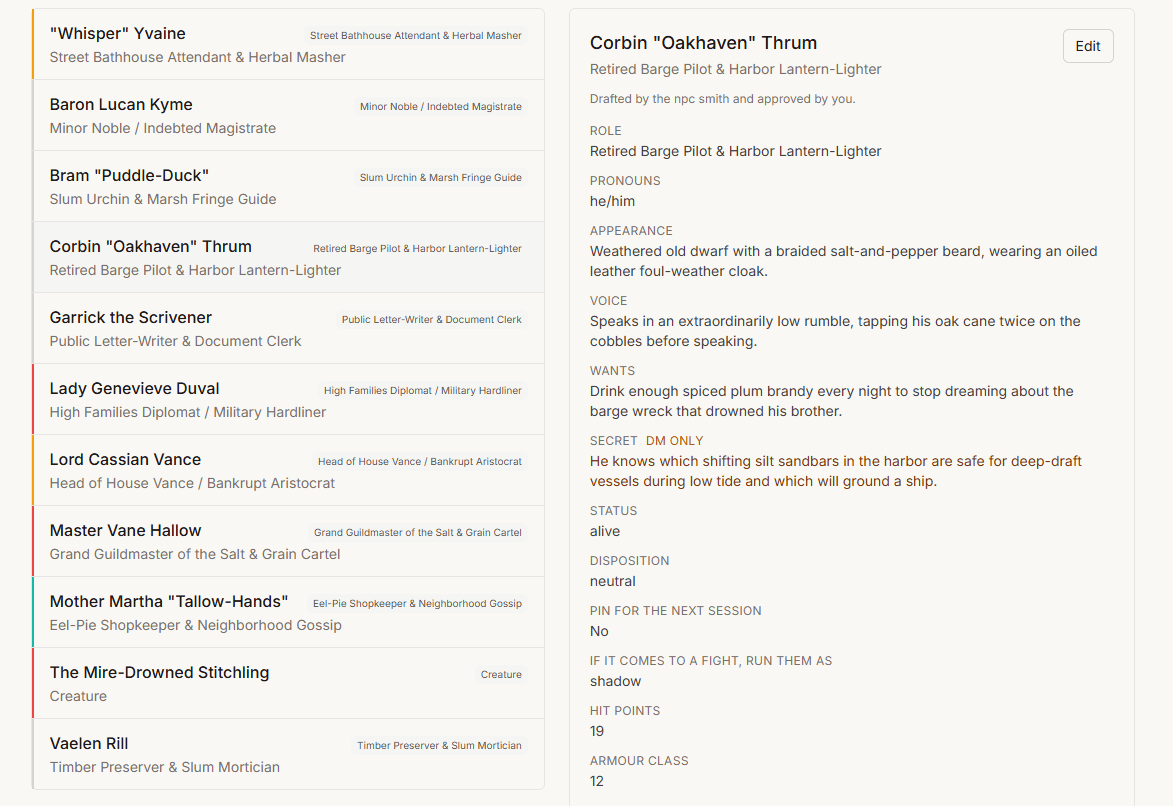
People, places, factions, items, threads, creatures and characters. Each has fields of its own and a list of facts attached, and each knows what else refers to it — so deleting a place tells you which NPCs stood in it.
Facts have a beginning and an end
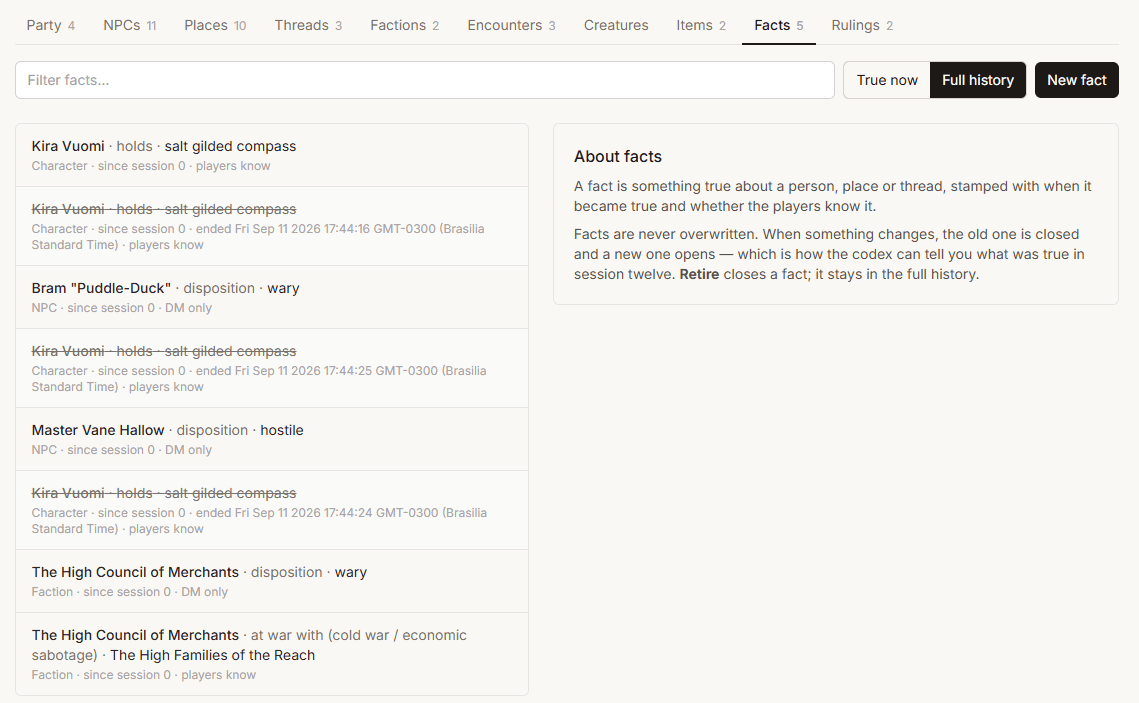
Every fact records when it became true and, when something supersedes it, when it stopped. Nothing is edited over the top and nothing is deleted.
So the codex can answer three different questions:
- What is true now? The facts with no end date.
- What was true in session 14? The ones open at the time.
- What changed, and when? The whole history of anything.
One NPC, across a campaign
Aldric Fenn · disposition
wary — session 12 to session 29
cooperative — session 30 to session 33
ally — session 34 to now
Which is how the Continuity Auditor works
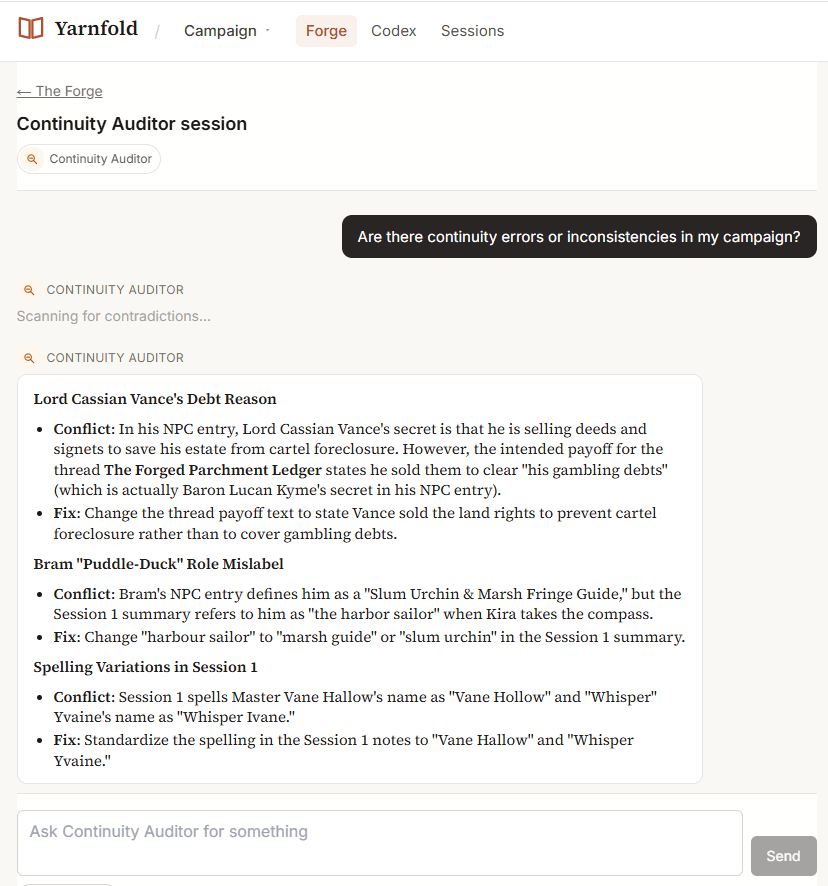
Your notes say Aldric is dead. Session 34 has him in a scene. The codex holds both, with dates, so the disagreement is simply there to be found.
The Continuity Auditor in the Forge does the finding, and the debrief runs the same checks over your campaign after your approved changes land — the moment a contradiction is cheapest to fix, because you still remember the context.
What it actually looks for:
- Someone recorded as dead who is still turning up in scenes.
- An entity whose own record disagrees with its live facts.
- Resolved threads still being planned around.
- Two live facts saying different things about the same subject.
- Facts attached to things that no longer exist.
- Threads gone cold, or with no payoff written down.
- A player who has not had the spotlight for too long.
Threads are what is unresolved
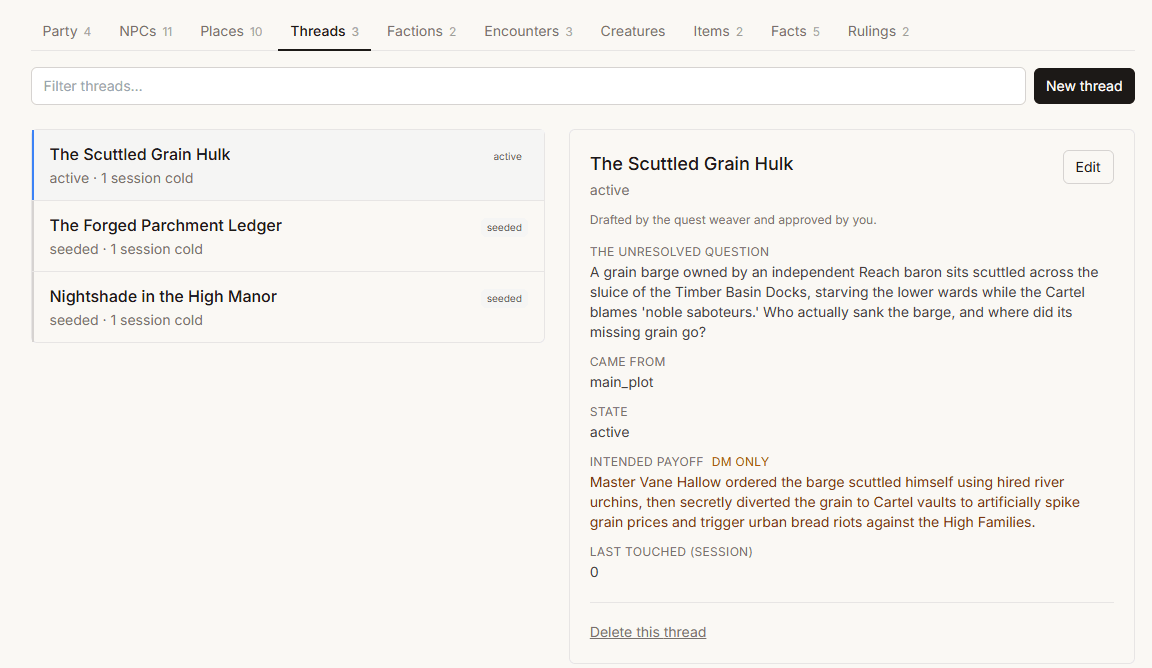
A thread is a promise, a debt, a mystery or a plan that has not landed. They have states — seeded, active, stalled, resolved, abandoned — and, more usefully, they know how long it has been since anyone touched them.
That is what Going cold on your dashboard reads. Not everything unresolved, which would be overwhelming, but the ones quiet long enough that your players have probably stopped expecting them.
Nothing enters your campaign unread
The assistant proposes. You approve. That is the whole arrangement, and it is enforced rather than intended — every path that could write to your campaign goes through something you see first.
- Debrief changes must quote the words they came from, and one that cannot is discarded before it reaches you.
- Forge drafts wait on the bench until you accept them.
- Imports show you every person and place before writing one.
The reason is not caution for its own sake. A campaign you cannot trust is worse than no campaign at all — you would end up checking everything against your old notes, which is the work you were trying to stop doing.
What this adds up to
Session five, none of this matters. You remember everything.
Session thirty, the codex knows things you have forgotten, can tell you what was true when, and warns you before you contradict yourself in front of five people. That is the whole bet: the longer the campaign runs, the more it is worth.
Questions
Questions people ask
No. Drop in a Notion or Obsidian export, a Word file, or paste anything at all. Yarnfold reads the people, places, factions and past sessions out of it and shows you every one before a word is written. If it is all in your head instead, answer nine questions and it builds from that.