For dungeon masters and game masters
Less bookkeeping. More game.
Yarnfold helps you keep your campaign’s wiki organised, prep sessions much faster and run your table with ease. You focus on the plots, monsters, NPCs, twists and places the way only a DM can. Yarnfold takes care of the bookkeeping: the notes, the stat blocks, the initiative and who knows what.
Thirty sessions in already? Bring them. Drop in your Notion or Obsidian export, a Word file, or paste your notes. In a few minutes your NPCs, places, factions and past sessions are in. You check each one before it is saved, and you never rewrite a wiki from scratch.
Step 1 of 5
Import your campaign
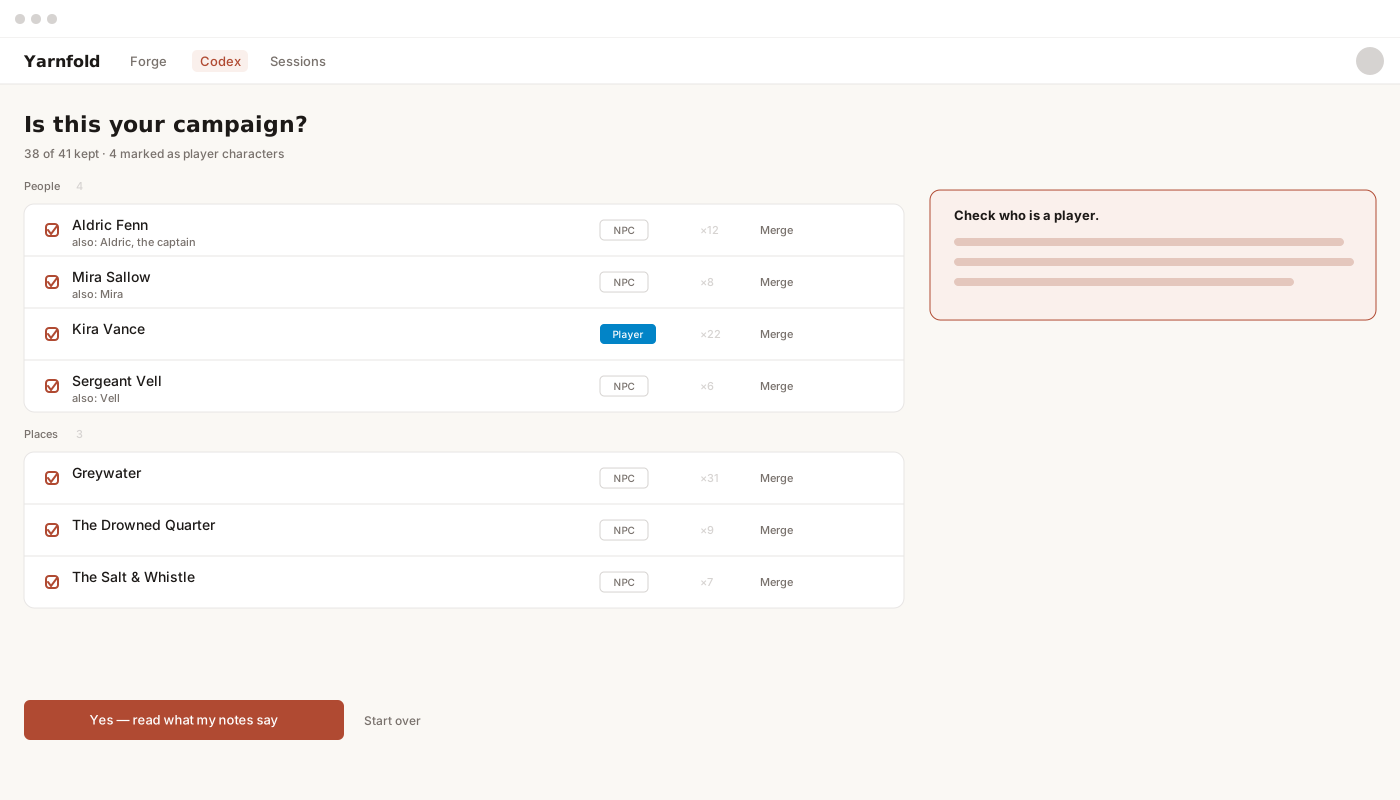
Drop in a zip of your notes, a document or a paste. Or just talk through your campaign for a few minutes.
Import your campaign
Drop in a zip of your notes, a document or a paste. Or just talk through your campaign for a few minutes.
Yarnfold reads it all, checks with you who is who, and turns it into a clean, linked codex.
Manage and expand your wiki
NPCs, places, facts, party members, items and creatures, all linked and one search away.
Need more? Ask the Forge, a writers’ room of specialists that already knows your world.
Prep your session
Lay the session out as scenes on a map, connected the way your players might go.
Sketch it in a few lines and the assistant drafts the scenes, the fights and the read-aloud text.
Print it all on one sheet, or take it straight to the table on screen.
Run your session
Your scenes, read-aloud text and notes, at a glance.
Initiative, hit points, conditions and every creature’s stats, a tap away.
Play the soundtrack, look up and save rulings, and improvise when they go off-script.
Debrief in a few minutes
Say what happened, on your phone or your laptop. Your codex is up to date and ready for next session.
What you said, after the session
“Right, so they finally cornered Aldric in the harbour office and he admitted the manifest was short. Kira took a page out of the ledger. Vell followed them back to the Salt and Whistle and I think he’s not actually on the take.”
- Aldric Fenn: wary → cooperativefrom “he admitted the manifest was short”
- Kira carries a page from the Guild ledgerfrom “Kira took a page out of the ledger”
- Thread “Is Vell paid off?”: seeded → activefrom “I think he’s not actually on the take”
Every change quotes your own words. Add what is right, edit what is close, discard the rest. Your codex is up to date before the dice are packed away.
Bring your campaign
Months of sessions in. Minutes to move in.
Your campaign lives in a Notion workspace, an Obsidian vault, a Google Doc and your head. Drop in what you have. Yarnfold works out who is who (it knows “Uncle Bran” and “Brannoc Ironvein” are the same dwarf) and fills in every person, place, faction and item with what your notes say about them.
You review each entry before it is saved, and past sessions come in as history, so your world arrives with its story already in it. No notes at all? Answer nine questions and it builds a starting codex from your answers.
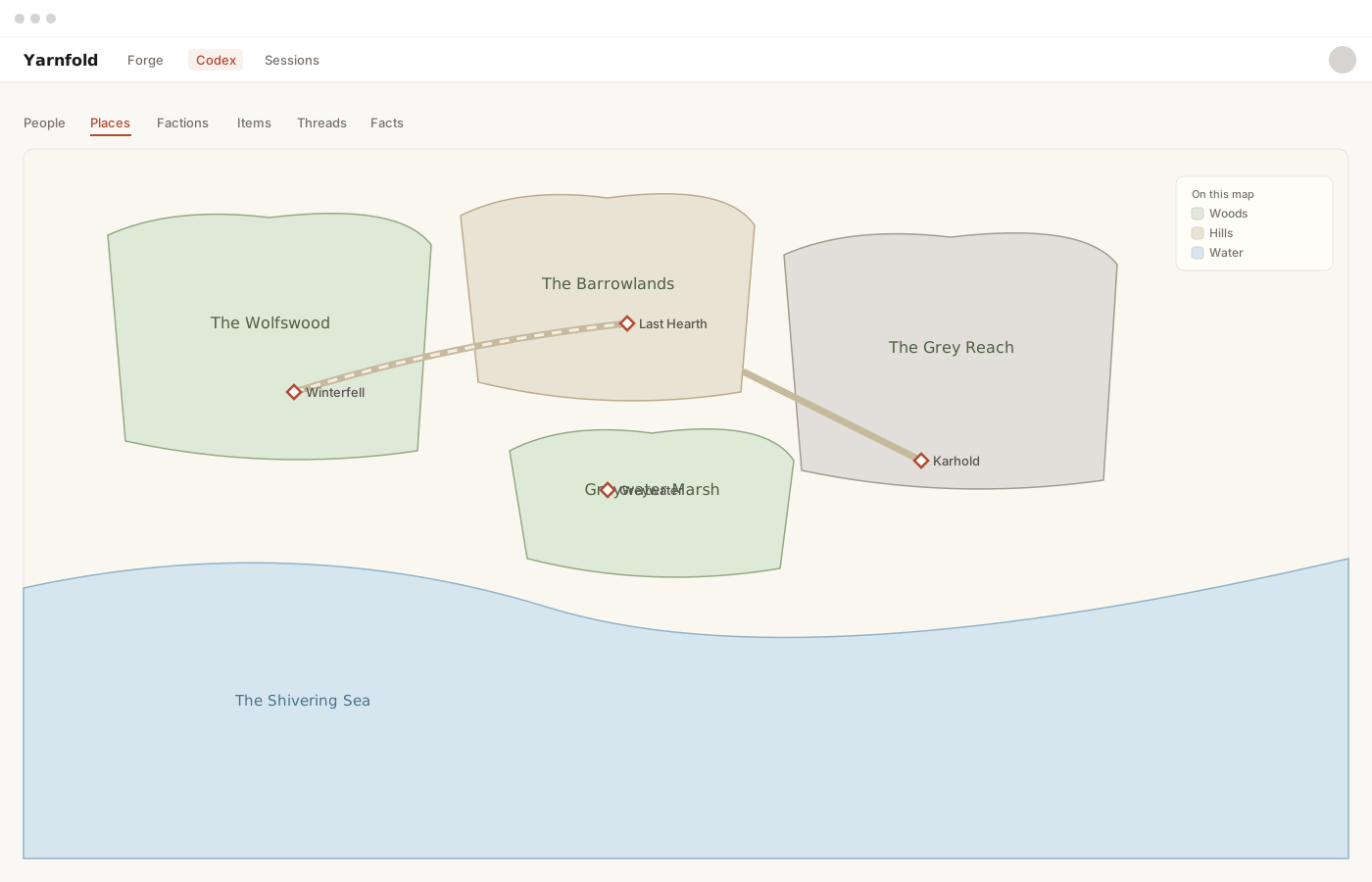
Your codex
A campaign wiki that keeps itself up to date.
Every NPC, place, faction, item and plot thread, linked to each other, with a history of what changed and when. Who is dead, who owes the party a favour, who knows the secret: one search away, even mid-session.
It catches your contradictions before your players do: a dead NPC booked into next week’s scene, a solved mystery your prep still hinges on. And draw the world as you go, from regions and roads to cities, with every place on the map a page in the codex.
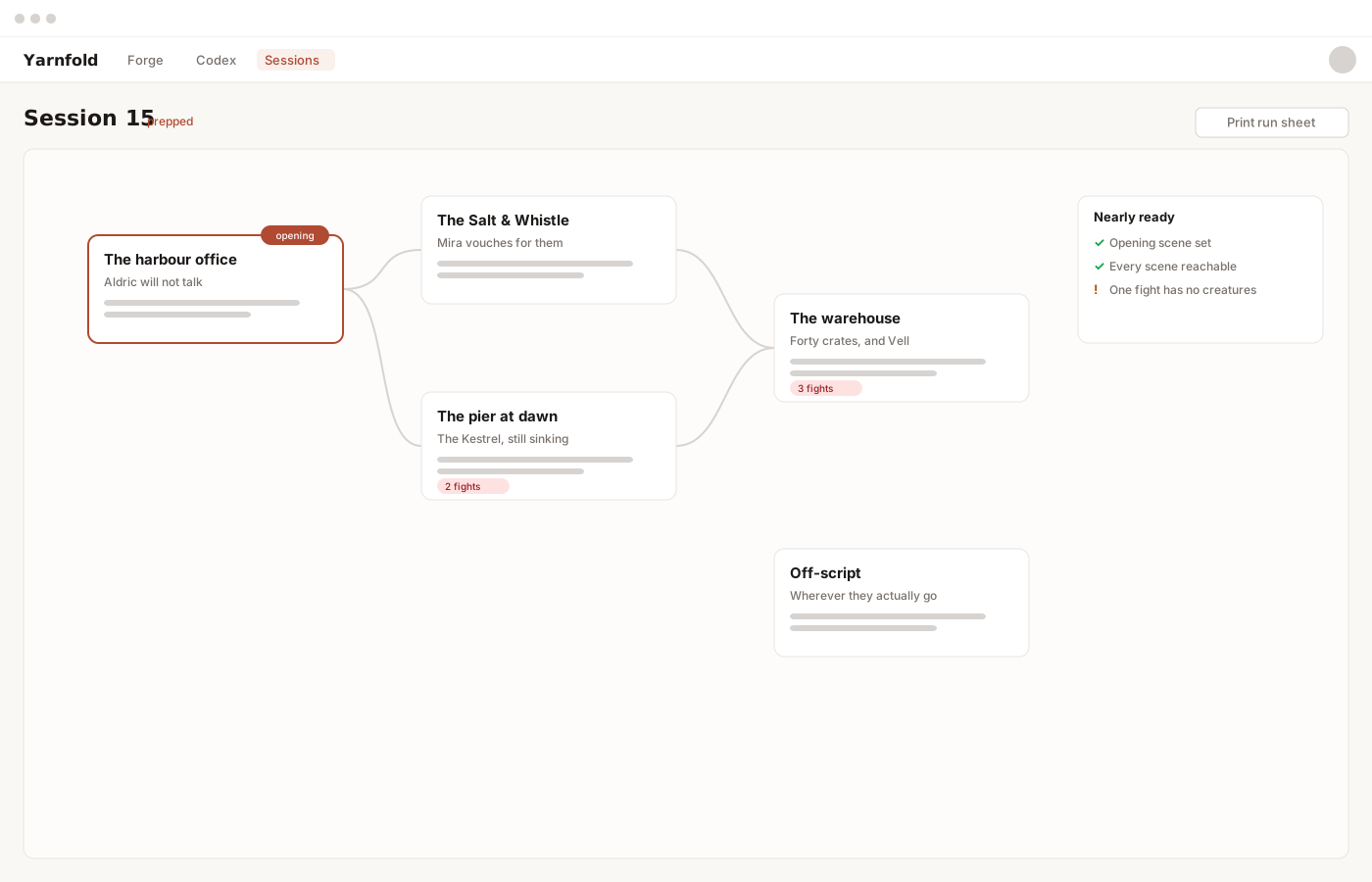
Session prep
Prep the fun parts. Hand off the grind.
Lay the session out as scenes on a board, because players never go in a straight line. Spend your time on what you love writing: the villain’s offer, the double-cross, the tavern that is not what it seems.
Then hand off the rest. Sketch a session in a few lines and the scenes are drafted with your own NPCs and places in them. Encounters come balanced for your party with every stat block attached, and each scene gets its read-aloud text and its music. You edit; you do not start from a blank page.
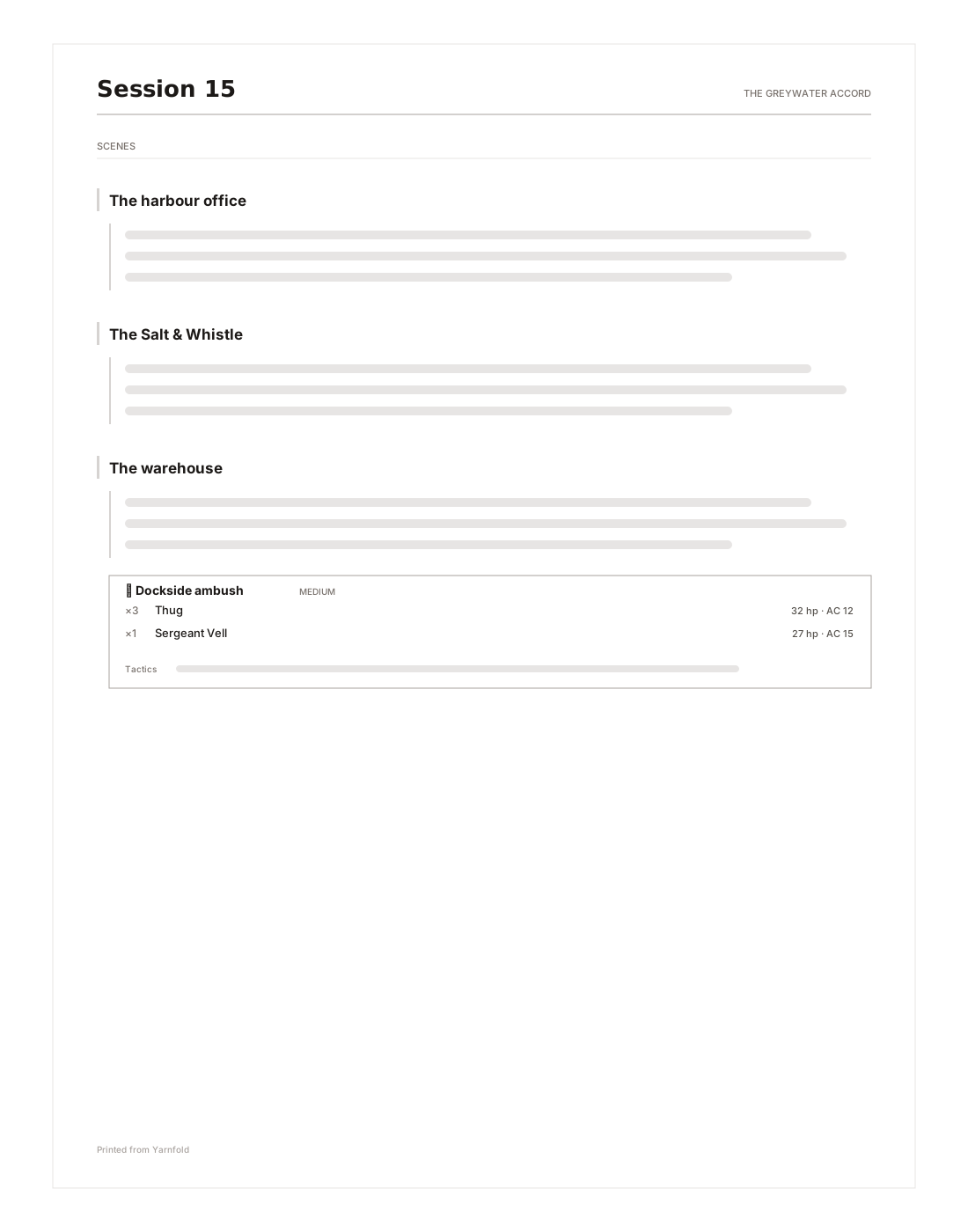
Playing around a table?
Run the whole night from one printed sheet.
No laptop wall between you and your players. Print a run sheet: every scene in order, its read-aloud text, your notes, whose turn it is in the spotlight, and the full stat block for every creature you might need.
Scribble on it as you play, then debrief from your phone on the way home.
At the table
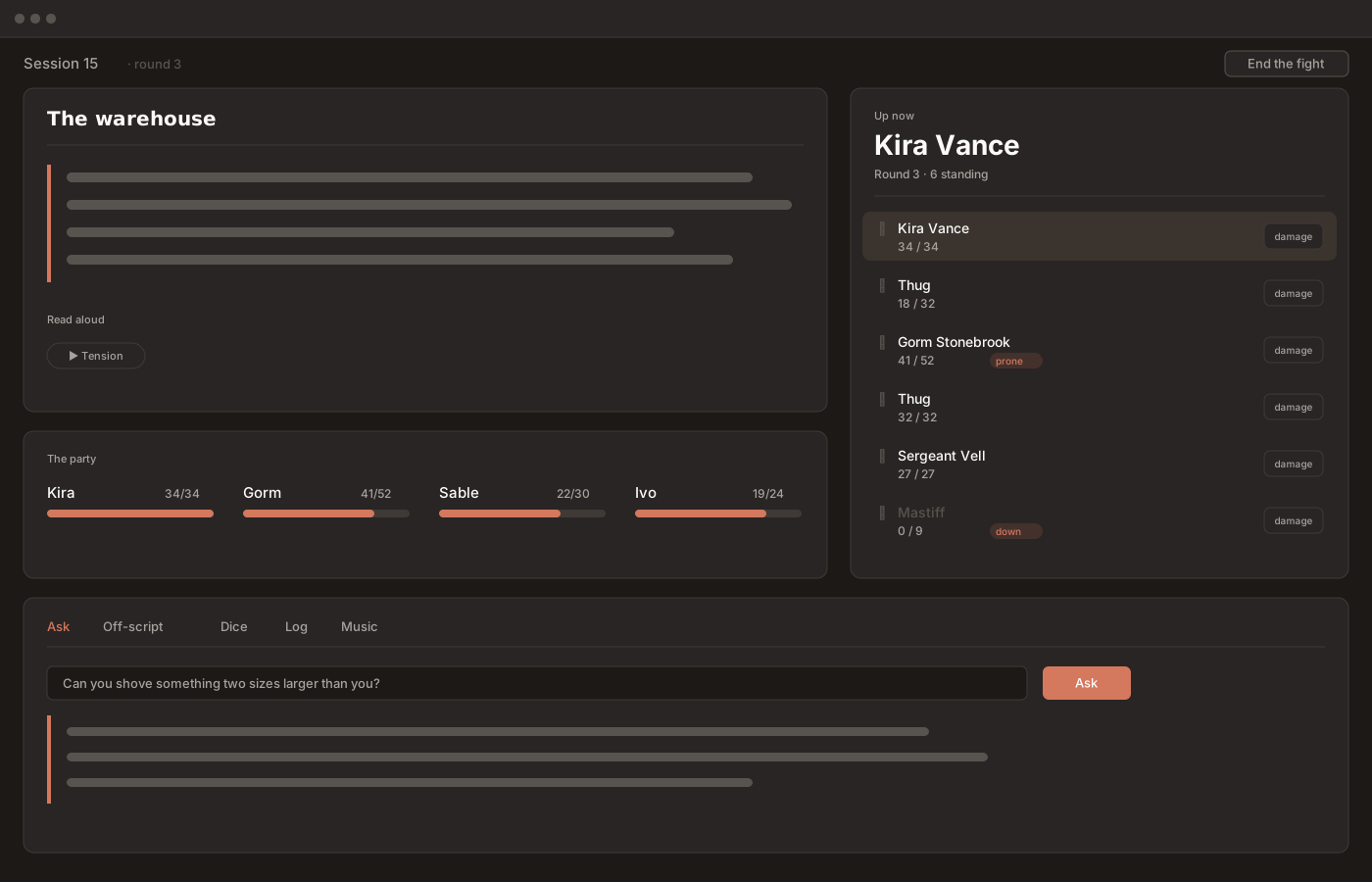
One screen for everything that happens mid-session.
The scene you are in, initiative you drag into order, hit points, conditions, dice, every creature’s attacks a tap away, and the music for the moment, all on a dark screen made to be read at a glance across the table.
When the players do what you never planned for, ask a rules question and get a straight answer, or say where they have wandered and get a scene with something to read aloud in seconds. Jot a note as it happens; it is waiting for you afterwards.
After the session
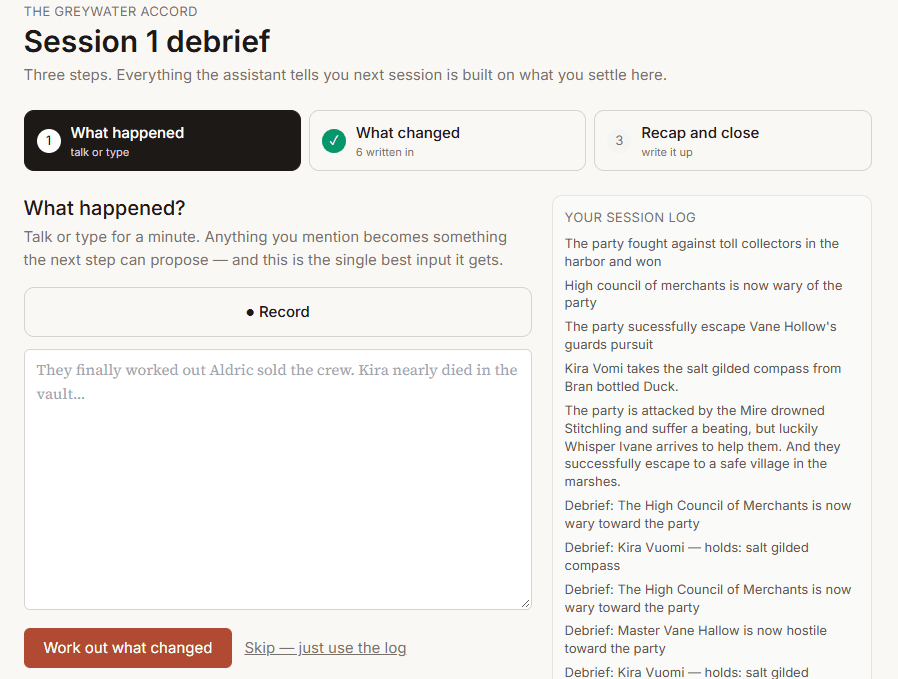
Two minutes of talking. Your whole campaign, up to date.
The job every DM means to do and nobody does: updating the notes. Talk or type for a minute about what happened. Yarnfold reads that, your notes from the night, the scenes you played and your codex, and comes back with every change: who died, who turned on the party, which mystery got solved, who walked off with the cursed dagger.
Each one shows the words it came from. Add, edit or discard in a few taps, and next week’s prep starts from where the party actually stopped, not from where you planned they would.
The Forge
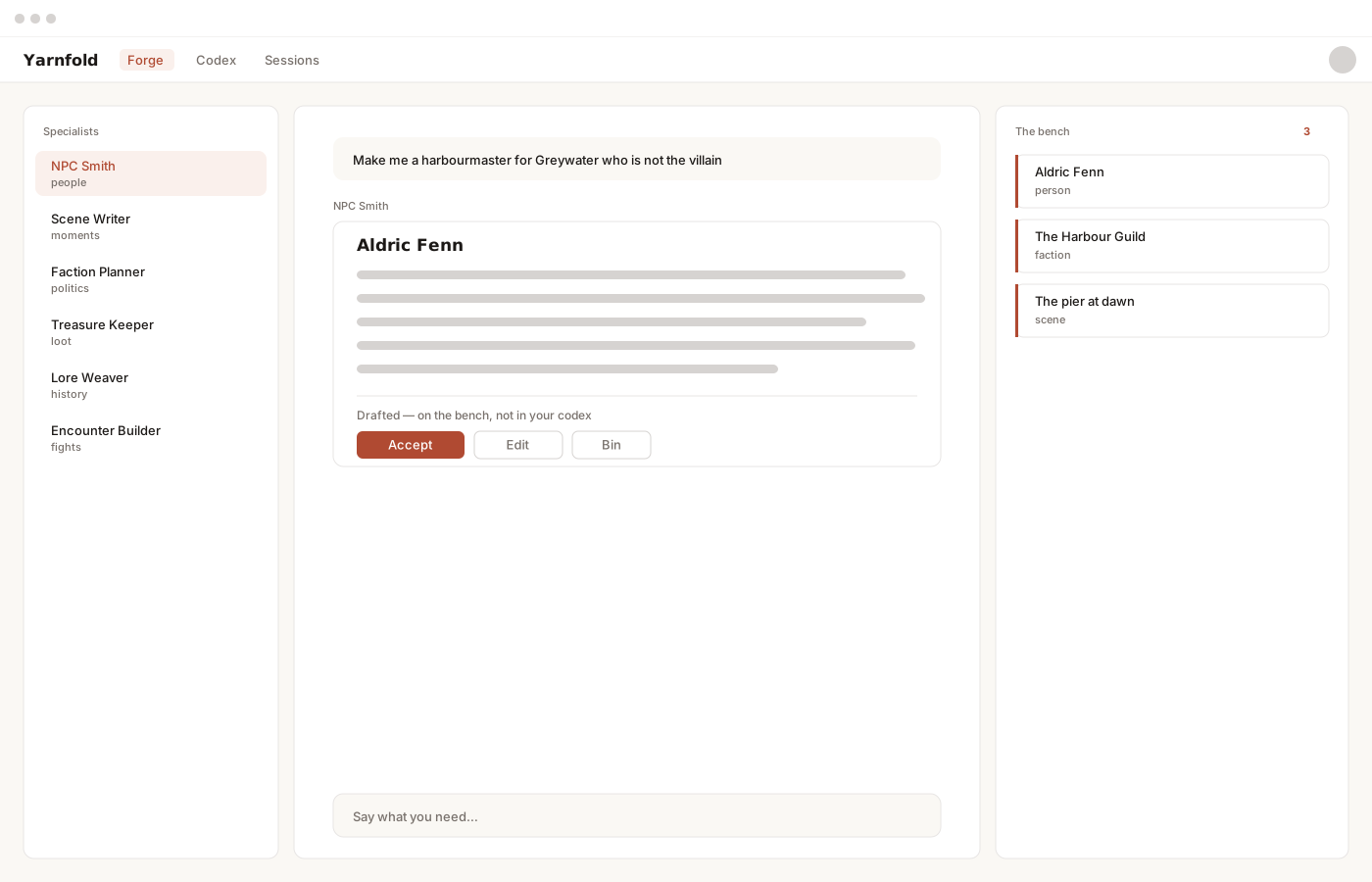
A writers’ room that has already read your campaign.
Thirteen specialists: an NPC smith, a location builder, a villain architect, a faction planner, a loot keeper, a rules consultant and more. Ask for a rival for the paladin, a town on the road north, a heist the party can botch three ways. They already know your world, so you never explain the setup, and what comes back fits it.
Everything arrives as a draft: keep it, rewrite it or bin it. The world stays yours; they just save you the blank page.
One tab instead of seven.
Fewer places to look means less to keep in your head, and more of you left for the table at the end of a long week.
Yarnfold replaces
- The wiki you stopped updating in session nine
- The spreadsheet of NPCs and who they hate
- The notes app full of half-sentences from the table
- The initiative tracker and the stat block tabs
- The music playlist you scramble for mid-fight
- The sticky notes on the inside of your DM screen
What you still bring
- Your players, and your dice.
- Playing online? A virtual tabletop for the map and tokens.
- Around a table? Your minis, maps and props.
Everything else lives here.
Is this for you?
Probably yes
- Your homebrew campaign has outgrown your notes, and you feel it every session.
- Your Notion, Obsidian or Google Doc is months behind and you keep meaning to fix it.
- Prep is starting to feel like a second job, or you run more than one table.
- You have contradicted yourself in front of your players, or forgotten an NPC they loved.
- You are starting a new campaign and want it organised from session one.
Probably not
- You run published adventures straight from the book, and that works for you.
- You improvise everything, write nothing down, and like it that way.
We would rather you knew now than found out in three weeks.
About the assistant
Plenty of DMs want nothing to do with AI in their creative work, and that is a perfectly reasonable position. So here is exactly what it does: the clerical work. Filing what happened, matching names to records, drafting a stat block or a first pass at a scene for you to rewrite.
It suggests; you decide. Nothing goes into your campaign until you add it, every suggestion shows the line of your own notes it came from, and nothing you write is used to train anything.
And if you would rather it were not there at all, Hand Written has none of it: the codex, the world map, the prep board, the table view and the combat tracker, and not a word written by a machine.
Questions people ask
No. Drop in a Notion or Obsidian export, a Word file, or paste anything at all. Yarnfold reads the people, places, factions and past sessions out of it and shows you every one before a word is written. If it is all in your head instead, answer nine questions and it builds from that.
Try it on the campaign you are already running.
Free for thirty days, no card. Bring your notes in a few minutes, run your next session with it, and keep everything you make whether you stay or not.